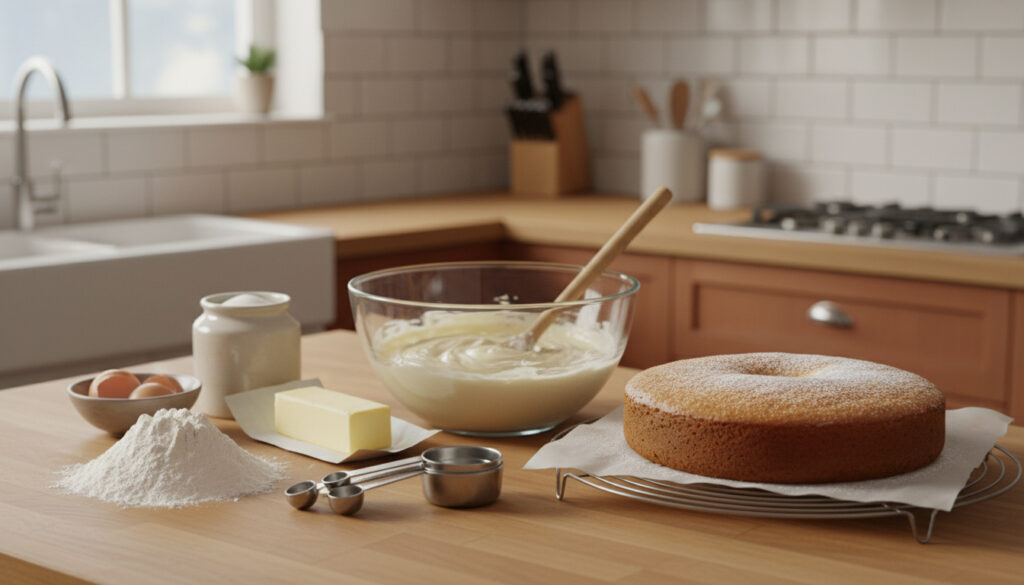
How to Bake a Cake – Step-by-Step for Beginners
Baking a cake from scratch requires precision, patience, and an understanding of how ingredients interact under heat. Unlike boxed mixes, homemade cakes demand attention to temperature, measurement accuracy, and mixing technique to achieve a tender, moist crumb that holds its structure.
A vanilla layer cake serves as the foundational recipe for most home bakers. Mastering this classic preparation provides the framework for countless variations, from chocolate to citrus to spice cakes. The process involves specific chemical reactions that begin the moment wet and dry ingredients combine.
This guide examines the essential components, step-by-step methodology, and critical temperatures required to produce professional-quality results in a standard home oven.
What Ingredients Do You Need to Bake a Cake?
- Room temperature ingredients emulsify properly, preventing batter separation
- Cake flour produces a more tender crumb than all-purpose alternatives
- Real vanilla extract significantly outperforms imitation in flavor depth
- Adequate creaming time incorporates air essential for rise
- Buttermilk or sour cream enhances moisture retention
- Spoon-and-level measuring prevents dense, dry textures
| Ingredient | Amount | Purpose |
|---|---|---|
| Cake flour | 2¼-2¾ cups | Tender structure |
| Baking powder | 2-2¾ tsp | Primary leavening |
| Baking soda | ½-¾ tsp | Acid activation |
| Salt | ¾-1 tsp | Flavor balance |
| Unsalted butter | ¾-1 cup | Fat content/richness |
| Granulated sugar | 1½ cups | Sweetness/structure |
| Large eggs | 3-4 | Binding/emulsification |
| Vanilla extract | 1-1½ Tbsp | Flavor profile |
| Milk or buttermilk | 1-1½ cups | Hydration/moisture |
The Easy Vanilla Cake Recipe for Beginners (From Scratch) relies on these core components measured precisely. Deviations in ratio or temperature alter the final texture significantly.
What Type of Flour Is Best for Cakes?
Cake flour contains less protein than all-purpose varieties, resulting in less gluten formation and a softer crumb. When cake flour is unavailable, all-purpose flour may substitute using the spoon-and-level technique to avoid packing excess weight into the measurement.
Can You Bake a Cake Without Eggs?
Eggs provide structure and emulsification, but alternatives exist for dietary restrictions. Replace three eggs with ¾ cup yogurt or applesauce plus ¼ cup additional milk, reducing sugar slightly to compensate for added sweetness. Vegan adaptations utilize flax eggs (one tablespoon flaxseed meal mixed with three tablespoons water per egg) and plant-based milk.
How to Bake a Cake: Step-by-Step Guide
Successful execution follows a specific sequence. Begin by preparing pans properly to prevent sticking. Grease two 8- or 9-inch round pans, line bottoms with parchment circles, grease the parchment, and dust with flour, tapping out excess.
Preheat the oven to 350°F (175°C), or 325°F for darker pans. Whisk dry ingredients—flour, baking powder, baking soda, and salt—in a separate bowl. Cream softened butter and sugar until pale and fluffy, approximately two to five minutes, then incorporate eggs individually followed by vanilla extract.
Insert a toothpick into the center at the minimum bake time. The cake is finished when the toothpick emerges with a few moist crumbs clinging to it, not wet batter. Alternatively, the center should spring back when lightly pressed.
How Long Does It Take to Bake a Cake?
Standard layers require 20 to 30 minutes depending on pan size and material. Two 9-inch rounds typically finish at the shorter end of the range, while 8-inch pans require 25 to 35 minutes. Three 6-inch pans run 18 to 25 minutes. Rotation halfway through ensures even browning in ovens with hot spots.
How Do You Know When a Cake Is Done Baking?
Visual cues include slight pulling from pan edges and a golden surface. Tactile verification remains most reliable. Baking specialists emphasize cooling cakes in pans for exactly ten minutes before inverting onto wire racks. Premature removal risks breaking; delayed removal causes sticking.
What Temperature and Tools for Perfect Cake Baking?
Precision instruments ensure consistency. Required tools include two 8- or 9-inch round cake pans, parchment paper, a stand or hand mixer with paddle attachment, measuring cups and spoons, silicone spatulas for scraping, and wire cooling racks. A cake tester or wooden toothpick provides the most accurate doneness assessment.
Overmixing activates gluten, producing dense, tough cakes rather than tender layers. Mix dry and wet ingredients only until flour disappears. Small lumps in the batter are preferable to extended mixing.
Cold ingredients prevent proper emulsion, causing batter to curdle or separate. Butter should yield to gentle pressure but not appear melted. Eggs and dairy must sit at room temperature for thirty minutes prior to mixing.
What Are the Basic Tools for Baking a Cake?
Beyond pans, accuracy depends on measurement tools. Use graduated cups for dry ingredients and clear spouted cups for liquids. A kitchen scale provides superior precision, particularly for flour. Demonstrations show that packed flour weighs significantly more than spooned flour, directly impacting density.
How to Bake a Moist Cake?
Moisture retention depends on fat selection and mixing method. Adding ½ cup neutral oil alongside butter increases moisture without sacrificing the creaming method’s structural benefits. Buttermilk or sour cream maintains tenderness for three to four days when stored properly. Professional testing confirms that wrapping cooled layers tightly in plastic before freezing preserves texture for up to three months.
Common Mistakes to Avoid When Baking a Cake
Dense textures usually result from overmixing or improper measuring. Spoon flour into measuring cups rather than scooping directly from the bag, which compacts the starch. Overbaking dries the crumb; begin testing five minutes before the stated minimum time.
Opening the oven door during the first fifteen minutes causes temperature shock that collapses the rising structure. Recipe developers note that alternating dry and wet ingredients in three batches, starting and ending with dry, prevents tough gluten development while maintaining emulsion stability.
Using dark or glass pans without temperature adjustment leads to over-browned exteriors and raw centers. Reduce heat to 325°F and extend baking time slightly when using these materials.
How Does the Cake Baking Process Unfold?
- Preparation (15 minutes): Preheat oven, grease and line pans, bring ingredients to room temperature.
- Mixing (10-15 minutes): Cream butter and sugar, incorporate eggs, alternate adding dry ingredients and milk in three batches. Source: Liv for Cake
- Baking (20-30 minutes): Divide batter between prepared pans, smooth surfaces, bake until toothpick tests clean with moist crumbs.
- Cooling (70+ minutes): Rest in pans 10 minutes, invert onto wire racks, remove parchment, cool completely before frosting. Source: Sally’s Baking Addiction
What Baking Facts Are Established vs. Variable?
| Established Information | Variable Factors |
|---|---|
| Standard baking temperature is 350°F (175°C) | Exact timing varies by altitude and oven calibration |
| Toothpick test confirms doneness when few moist crumbs adhere | Dark pans require temperature reductions not standardized across brands |
| Room temperature ingredients prevent curdling and ensure emulsion | Humidity affects flour absorption rates significantly |
Why Do These Techniques Work?
The creaming method mechanically forces air into butter and sugar, creating nucleation sites for carbon dioxide produced by baking powder and soda. This cellular structure sets during baking, determining final volume and texture.
Protein content governs gluten formation. Cake flour’s lower protein (approximately 8%) compared to all-purpose (10-12%) limits gluten development, yielding tenderness. Acidic components like buttermilk activate baking soda while denaturing proteins to create finer crumbs.
What Do Professional Bakers Recommend?
Stick to recipe first—no mods for beginners. Creaming method produces superior classic texture compared to reverse creaming. Vanilla quality matters significantly.
— Liv for Cake Baking Specialists
High butter and sugar creaming time builds structure and air incorporation essential for lift.
— Budget Bytes Kitchen Testing
Ready to Bake Your First Cake?
Gather room temperature ingredients, verify oven accuracy, and follow the sequence without shortcuts. For a reliable starting point, review the Classic Vanilla Cake methodology, then adapt flavors once you have mastered the base technique.
Frequently Asked Questions
What temperature should I bake a cake at?
Most recipes require 350°F (175°C) for standard metal pans. Dark or glass pans perform better at 325°F to prevent excessive browning. Always preheat fully before inserting batter.
Can I use all-purpose flour instead of cake flour?
Yes, though cake flour yields a tenderer crumb. Substitute using the spoon-and-level method, or remove 2 tablespoons per cup of all-purpose flour and replace with cornstarch.
Why is my cake dense and heavy?
Overmixing develops gluten, creating toughness. Mix dry and wet ingredients just until combined. Also ensure eggs and butter reach room temperature before creaming to maintain proper emulsion.
How should I store a baked cake?
Wrap cooled layers tightly in plastic wrap. Store unfrosted at room temperature for 24 hours or freeze up to three months. Frosted cakes require refrigeration if perishable fillings are present.
Can this recipe be made vegan?
Substitute butter with coconut oil, eggs with flax eggs (1 tablespoon flaxseed mixed with 3 tablespoons water per egg), and dairy milk with almond or oat milk. Reduce flour slightly to prevent gumminess.
Why did my cake sink in the middle?
Opening the oven door prematurely causes temperature shock. Additionally, underbaking or expired leavening agents prevent proper structure formation. Verify baking powder freshness before starting.
Is it better to use butter or oil in cake?
Butter provides flavor and structure through creaming. Oil increases moisture retention. Many recipes use both—butter for taste, oil for texture—to achieve optimal results without density.
More related posts
 Symptoms of Low Blood Sugar – Early Warning Signs and What to Do
 Arsenal vs Atlético Madrid: Head-to-Head, Prediction, Tickets
 Ryan Phillippe: Life, Career, and Split from Reese Witherspoon
 Joe Walsh: Eagles Guitarist, Health, and Political Views
 Edward Herrmann Cause of Death: Brain Cancer Details
 Phil Mickelson: Absence, Illness, Wealth, and Wife
 Prince Edward County Hotels – Top Stays for Wine Country Escapes
