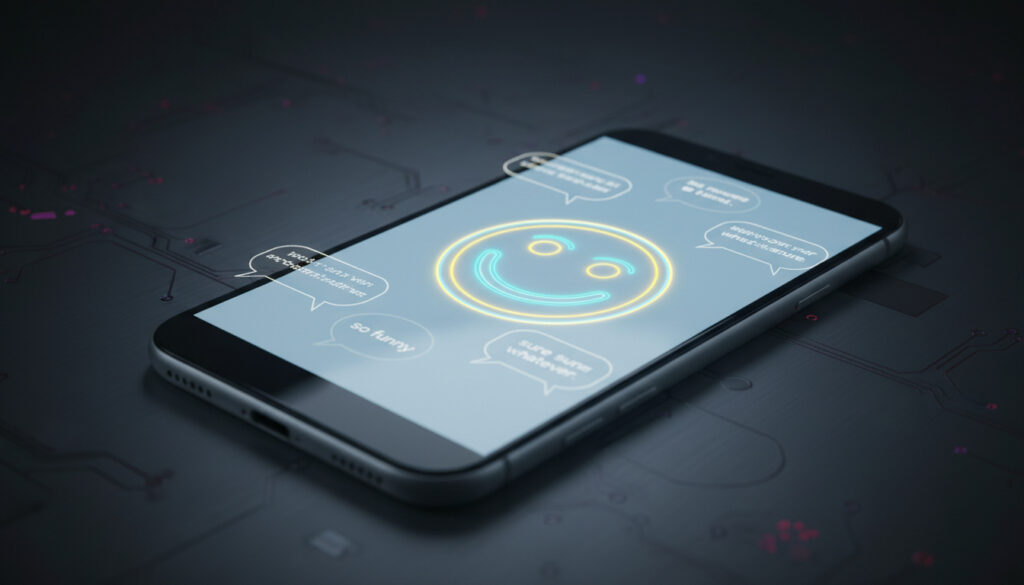
Upside Down Smiley Emoji – Meaning, Usage and Guide
The 🙃 upside-down smiley emoji has become a versatile tool in digital communication, primarily signaling sarcasm, irony, or playful absurdity. First introduced to Unicode in 2015, this yellow smiley flipped on its head suggests sentiments not meant to be taken at face value, functioning as a visual cue for tone where text alone might fail.
Unlike standard smileys that convey straightforward happiness, the inverted design creates immediate visual dissonance. This dissonance allows the symbol to represent complex emotional states—ranging from passive resignation to flirtatious teasing—depending entirely on conversational context and accompanying text.
What Does the Upside-Down Smiley Emoji 🙃 Mean?
- Conveys irony or joking reversal similar to “/s” text markers
- Represents “smiling through the pain” during frustrating scenarios
- Functions as a digital equivalent to earlier kaomoji expressions
- Maintains consistent rendering across iOS, Android, and desktop platforms
- Serves rare but documented use in flirtatious digital exchanges
- Communicates passive aggression or resigned acceptance of misfortune
- Requires contextual cues to determine specific emotional intent
| Attribute | Detail |
|---|---|
| Emoji | 🙃 |
| Official Name | Upside-Down Face |
| Unicode Point | U+1F643 |
| Unicode Version | 8.0 (2015) |
| Category | Smileys & Emotion |
| Shortcode | :upside_down_face: |
| Primary Function | Sarcasm/Irony indicator |
| Secondary Functions | Playfulness, awkwardness, resignation |
| Platform Variation | Minimal across major systems |
| Access Method | Emoji picker search |
The meaning shifts dramatically based on surrounding text. A message ending with 🙃 after bad news suggests resignation, while the same emoji after a joke reinforces sarcastic intent.
How to Make or Type the Upside-Down Smiley Face
Desktop Operating Systems
Windows users access the character through the Win + . (period) shortcut to open the emoji picker, then search for “upside down face.” Video demonstrations confirm this method works across Windows 10 and 11. On macOS, the combination Cmd + Ctrl + Space opens the Character Viewer, where searching produces the same result.
Mobile Devices
Both iOS and Android keyboards include the emoji within the “Smileys & Emotion” category. Users can also long-press the standard smiley and select the inverted variant on some keyboard applications, though availability varies by app developer.
On Windows, Win + . opens the picker immediately. On Mac, Cmd + Ctrl + Space launches the Character Viewer without navigating menus.
Copy and Paste the Upside-Down Smiley Emoji
For immediate insertion, the character 🙃 can be copied directly from this page and pasted into text fields, social media posts, or messaging applications. The Unicode standard ensures the symbol retains its formatting across different operating systems and browsers, appearing as an inverted yellow smiley regardless of the destination platform.
When pasting into rich text editors or email clients, the emoji renders at the default size specified by the application’s font settings. No additional coding or HTML entities are required for standard usage, though web developers can reference the specific point U+1F643 if implementing the character in styled content.
Technical Details: Unicode and Release of 🙃
Standardization History
The Upside Down Face received formal approval in Unicode 8.0 during mid-2015, appearing in the initial release of that standard version. This placement predates later emoji expansions, establishing the character as part of the early modern emoji lexicon rather than a recent addition. Emoji database archives confirm this specification history.
Rendering Consistency
Analysis from digital communication researchers indicates the upside-down smiley maintains remarkable consistency across platforms. Unlike other emojis that shift dramatically between Apple, Google, and Samsung devices, this character’s simple geometric inversion renders nearly identically everywhere, reducing risks of cross-platform misinterpretation. Platform design guidelines support this standardization.
Devices running operating systems from before 2015 may not display this emoji correctly, showing an empty box or replacement character instead of the intended symbol. Unicode Consortium documentation provides compatibility details.
When Did the Upside-Down Face Join Digital Standards?
-
: You can learn more about this topic by taking the prova del espectre autista AQ10.
Approved as part of Unicode 8.0 specification, establishing the character code U+1F643 and initial standardization.
-
:
Full platform implementation completed across major mobile operating systems, with iOS and Android releasing updates supporting the new Unicode standard.
-
:
Continued prevalence in social media communication and meme culture, with usage expanding beyond original sarcastic contexts into broader expressions of digital absurdity.
Established Facts Versus Contextual Interpretations
| Established Information | Contextual Interpretations |
|---|---|
| Unicode standard U+1F643 | Specific emotional intent varies by conversation |
| Released in Unicode 8.0 (2015) | May signal sarcasm, playfulness, or resignation |
| Visual design: inverted smiley | Interpreted as flirting when paired with certain emojis |
| Cross-platform consistency confirmed | Cultural meanings shift across different age groups |
How Did Digital Culture Shape This Emoji?
The upside-down smiley emerged during a period when digital communication required increasingly nuanced emotional indicators. As documented by the Upside Down Face Emoji entry, the symbol filled a specific gap between the straightforward 😊 and overtly negative emojis, allowing users to express complex states like “positive yet frustrated” or “happy but confused.”
Its adoption parallels the evolution from early text-based kaomoji—such as (╯°□°)╯—to standardized Unicode characters. While Japanese emoticons required multiple keystrokes and specific cultural knowledge, the standardized 🙃 provides instant accessibility. This transition reflects broader shifts toward visual communication that transcends language barriers while maintaining the ambiguity necessary for casual digital banter.
Expert Perspectives and Source Citations
This emoji features a classic yellow smiley face flipped upside down, suggesting something not to be taken seriously.
— EmojiTerra
The inverted smile implies the opposite of a happy face, similar to text markers like “/s” or “jk”.
— Digital Communication Analysis
What Should You Remember About the Upside-Down Smiley?
The Upside Down Face serves as digital shorthand for tone that text alone cannot convey, primarily indicating sarcasm while remaining flexible enough to express silliness or resignation. Its standardized Unicode implementation ensures reliable display across devices, making it a dependable tool for nuanced online communication since its 2015 debut.
Frequently Asked Questions
Is the upside down smiley always sarcastic?
What is the difference between 🙃 and 😏?
Does 🙃 look different on iPhone versus Android?
Can this emoji indicate flirting?
Why was the upside down face added to Unicode?
More related posts
 Gasoline Station Near Me: Ireland’s Best Petrol Options
 Pacini Trois-Rivières: Italian Menu, Bar à Pain & Reviews
 Air Canada Flight Tracker: Live Status & Maps
 Thor: Love and Thunder: Hit or Flop? Cast, Timeline & MCU Guide
 Pound Sterling to CAD: Exchange Rate, Foreca t & Conver ion Guide
 Megan Thee Stallion: Biography, Facts, Relationships & Net Worth
 Freida McFadden: Books, Real Name, Reading Order & Wig Explained
 Low Glycemic Index Foods: Complete Guide to Blood Sugar
