Ayatollah Khomeini: Revolution, Exile, and Largest Funeral
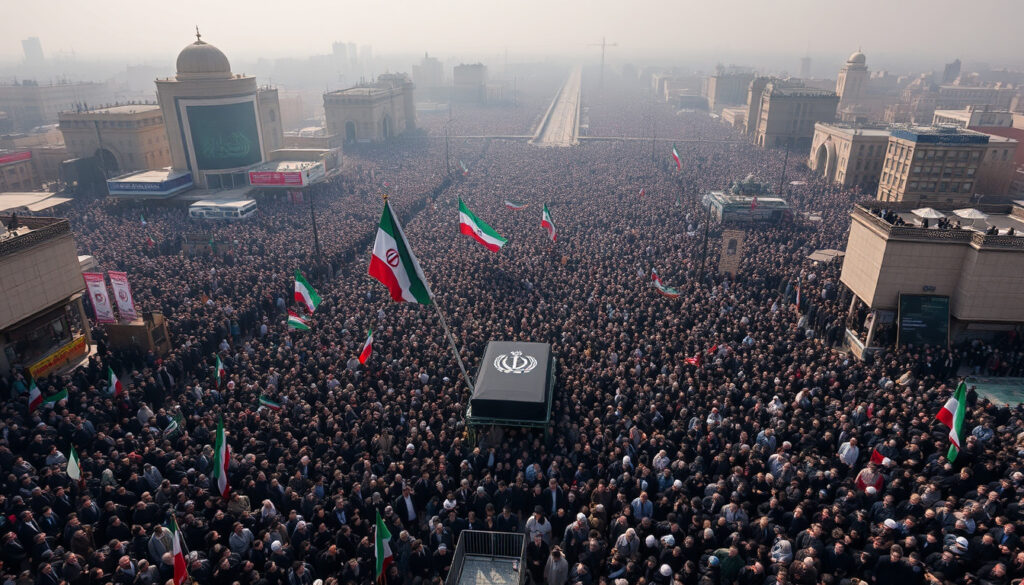
Few images from the 20th century are as striking as the sight of 10 million people flooding the streets of Tehran for a single funeral. That scene, in June 1989, was for Ayatollah Ruhollah Khomeini — the revolutionary cleric who had reshaped Iran and the Middle East a decade earlier.
Birth: 17 May 1900 ·
Death: 3 June 1989 ·
Role: First Supreme Leader of Iran ·
Funeral attendance: Estimated 10 million ·
Years in exile: 14 years (1965–1979) ·
Cause of death: Heart attack after surgery
Quick snapshot
- Led the 1979 Islamic Revolution that overthrew the Shah (Encyclopaedia Britannica)
- Became the first Supreme Leader of Iran in December 1979 (Encyclopaedia Britannica) (Encyclopaedia Britannica)
- Exiled for 14 years after criticizing the Shah’s reforms (Encyclopaedia Britannica) (Encyclopaedia Britannica)
- Exact death toll from the funeral stampede — estimates range from 8 to 20 (Guinness World Records)
- Total number of political executions ordered under his rule remains disputed (Guinness World Records)
- Whether the immediate cause of death was disclosed fully (Los Angeles Times)
- 1964: Exiled from Iran on 4 November (Encyclopaedia Britannica)
- 1 February 1979: Triumphant return from 14 years abroad (Los Angeles Times)
- 3 June 1989: Dies in Tehran after gastrointestinal surgery (Los Angeles Times)
- His successor Ali Khamenei has held power since 1989 (Encyclopaedia Britannica)
The key facts below offer a quick reference to the most important details about Khomeini’s life and death — a single snapshot of nine data points that anchor the deeper story.
| Attribute | Detail |
|---|---|
| Full name | Ruhollah Mostafavi Musavi Khomeini |
| Born | 17 May 1900, Khomeyn, Iran |
| Died | 3 June 1989, Tehran, Iran |
| Title | Ayatollah, Supreme Leader of Iran |
| Term | 3 December 1979 – 3 June 1989 |
| Funeral date | 4–5 June 1989 |
| Funeral attendance | ~10 million (largest in history) |
| Cause of death | Heart attack after gastrointestinal surgery |
| Wives | 1 (Khadijeh Saqafi) |
What was Ayatollah Khomeini known for?
The 1979 Iranian Revolution
- Khomeini, an Iranian Shiʿi cleric, led a popular revolution that overthrew Mohammad Reza Shah Pahlavi in 1979 (Encyclopaedia Britannica).
- The revolution ended 2,500 years of Persian monarchy and established Iran as an Islamic theocracy.
- Millions poured into the streets to welcome him when he returned to Tehran on 1 February 1979 (Los Angeles Times).
Founding of the Islamic Republic
- After a national referendum in April 1979, Iran became the Islamic Republic of Iran.
- Khomeini was appointed Supreme Leader for life in December 1979 (Encyclopaedia Britannica).
- The new constitution concentrated both political and religious authority in the Supreme Leader’s office.
Khomeini’s revolution promised broad popular representation, yet it created a system where one cleric held final authority over all three branches of government — a tension that defines Iranian politics to this day.
Khomeini’s role as Supreme Leader
- He consolidated power by suppressing political dissent and enforcing traditional Islamic laws.
- His regime ordered executions of political opponents, though the exact number remains disputed.
- Khomeini also issued the 1989 fatwa against author Salman Rushdie, which intensified Iran’s isolation from the West.
Khomeini did not merely lead a revolution — he invented a new model of clerical rule that merged Shia theology with statecraft. That model, Velayat-e Faqih, remains the constitutional foundation of Iran and a template for Shia movements from Lebanon to Iraq.
The implication: Khomeini’s political identity was inseparable from his religious authority. He was not a president or a king but a marjaʿ — a source of emulation — whose word carried spiritual weight alongside state power.
Why was Ayatollah Khomeini exiled from Iran?
The 1963 protests against the White Revolution
- In 1963, Khomeini led protests against the Shah’s “White Revolution” — a Western-backed reform program that included land redistribution and women’s suffrage.
- He denounced the reforms as un-Islamic and a threat to clerical authority.
- The Shah’s security forces arrested Khomeini, sparking nationwide unrest.
Exile to Turkey, Iraq, and France
- Khomeini was forcibly exiled from Iran on 4 November 1964 (Encyclopaedia Britannica).
- He first went to Turkey, then settled in Najaf, Iraq, where he spent 13 years teaching and writing (Encyclopaedia Britannica).
- In 1978, Saddam Hussein expelled him from Iraq, and he moved to Neauphle-le-Château, France.
Return in 1979
- On 1 February 1979 — just two weeks after the Shah fled Iran — Khomeini returned to Tehran aboard an Air France flight.
- The Los Angeles Times described his return as “triumphant,” with millions lining the streets (Los Angeles Times).
- At the time, the Shah’s army was still intact and Shahpour Bakhtiar remained as prime minister (Los Angeles Times).
The pattern: exile did not weaken Khomeini — it radicalized him. Cut off from Iran, he developed the doctrine of Velayat-e Faqih and prepared the ground for the revolution that would bring him home.
How many people died at Ayatollah Khomeini’s funeral?
The 1989 funeral stampede
- Khomeini died on the night of 3 June 1989 after a long illness (Al Jazeera).
- His funeral on 4–5 June drew an estimated 10 million mourners — the largest percentage of a population ever to attend a funeral (Guinness World Records).
- During the funeral, a stampede killed at least 8 people and injured 500 (Guinness World Records).
“Millions poured into the streets over the following three days to grieve his death.”
— Al Jazeera, reporting on the public response to Khomeini’s passing (Al Jazeera)
Official and media estimates
- Guinness World Records identifies the crowd at 10.2 million people lining a 32-km route to Behesht-e Zahra cemetery (Guinness World Records).
- That figure represented about one-sixth of Iran’s population at the time (Guinness World Records).
- Western agencies estimated about 2 million people paid respects as the body lay in state (Guinness World Records).
- Some reports suggest the death toll from the crush may have been higher than 8, though precise figures vary.
Comparison to other large funerals
- Khomeini’s funeral is widely regarded as the largest human gathering in history for a funeral.
- By comparison, Pope John Paul II’s 2005 funeral drew an estimated 4 million mourners.
- Mahatma Gandhi’s 1948 funeral procession drew about 2 million people.
What this means: the funeral numbers are not just a trivia record. They document the emotional and political weight Khomeini carried — a leader whose death triggered a collective response that overwhelmed Tehran’s infrastructure and made global headlines.
Why did Saddam fight Khomeini?
The Iran–Iraq War (1980–1988)
- Saddam Hussein invaded Iran in September 1980, launching the Iran–Iraq War that lasted eight years.
- The war resulted in over 1 million casualties and ended in a stalemate with no territorial changes.
- Khomeini saw the conflict as a fight against a secular, Ba’athist enemy that threatened the Islamic Republic.
Territorial disputes and ideological conflict
- Saddam aimed to seize oil-rich Khuzestan and toppling the new Islamic government before it could consolidate power.
- Tensions over the Shatt al-Arab waterway had been a flashpoint between the two countries for decades.
- The war became a vicious cycle of trench warfare, chemical attacks, and human-wave assaults.
Khomeini’s call to export the revolution
- Saddam feared that Khomeini’s Islamic Revolution would inspire Shia uprisings in Iraq, where Shia Muslims formed the majority.
- Khomeini openly called for the export of the Islamic Revolution across the region.
- The war ended in August 1988 after Khomeini reluctantly accepted a UN-brokered ceasefire, describing it as “drinking poison.”
Khomeini’s ideological ambition to export the revolution gave Saddam the justification he needed to invade. Yet the war — Iran’s longest and costliest conflict — also united Iranians around the new regime and solidified Khomeini’s role as a wartime leader.
The trade-off: the war killed hundreds of thousands, but it also hardened Iran’s national identity and cemented Khomeini’s image as a leader willing to sacrifice everything for principle.
Who succeeded Ayatollah Khomeini?
The selection of Ali Khamenei
- After Khomeini’s death, the Assembly of Experts chose Ali Khamenei — then the president of Iran — as the second Supreme Leader.
- Khamenei had been a close ally of Khomeini since the 1960s and served as Tehran’s Friday prayer leader.
- His selection was confirmed on 4 June 1989, the day after Khomeini’s death.
Constitutional changes after Khomeini’s death
- The Iranian constitution was amended to allow a cleric of lesser rank (not necessarily a marjaʿ) to serve as Supreme Leader.
- This change made Khamenei eligible for the role despite not holding the same religious credentials as Khomeini.
- The constitutional revision also abolished the post of prime minister and strengthened the presidency.
Khamenei’s role as second Supreme Leader
- Khamenei has held the position since 1989, making him the longest-serving head of state in the Middle East.
- Under Khamenei, the office of Supreme Leader has accumulated even more power, particularly over foreign policy and the military.
- Khomeini’s gold-domed tomb in Behesht-e Zahra cemetery remains a shrine for supporters (Encyclopaedia Britannica).
The implication: the succession of Khamenei — a figure of lesser religious stature but strong political instincts — redefined the Supreme Leader’s role. Khomeini was a revolutionary founder; Khamenei became a system manager. The shift from charisma to institutional power has defined Iran’s political trajectory for three decades.
Khomeini’s death created a succession crisis that forced Iran to rewrite its constitution. The solution — elevate a loyalist with political rather than theological authority — set a precedent that continues to shape the Islamic Republic’s leadership today.
Timeline of key events
- 1900 — Born in Khomeyn, Iran (Encyclopaedia Britannica)
- 1963 — Leads protests against Shah’s “White Revolution” (Encyclopaedia Britannica)
- 1964 — Exiled to Turkey, then Iraq (Encyclopaedia Britannica)
- 1978 — Moves to Neauphle-le-Château, France (Encyclopaedia Britannica)
- February 1979 — Returns to Iran after the Shah’s ouster (Los Angeles Times)
- April 1979 — Iran becomes an Islamic Republic after referendum (Encyclopaedia Britannica)
- December 1979 — Appointed Supreme Leader for life (Encyclopaedia Britannica)
- 1980–1988 — Iran–Iraq War (Encyclopaedia Britannica)
- June 1989 — Dies; funeral of 10 million mourners (Los Angeles Times)
Confirmed facts and what remains unclear
Confirmed facts
- Khomeini died on 3 June 1989 (Al Jazeera)
- His funeral was the largest in human history by percentage of population (Guinness World Records)
- He was exiled on 4 November 1964 for opposing the Shah’s reforms (Encyclopaedia Britannica)
- He was the first Supreme Leader of Iran (Encyclopaedia Britannica)
What remains unclear
- Exact death toll from the funeral stampede — estimates range from 8 to 20
- Total number of executions ordered under Khomeini’s rule is disputed
- Whether the immediate cause of death was disclosed fully (Los Angeles Times)
- Cause of death: reported as heart attack after gastrointestinal surgery, but the Los Angeles Times noted the announcement did not disclose the immediate cause or exact time
“A former Iranian diplomat said Khomeini’s funeral and his 1979 return from exile were the largest public gatherings in Iran’s history.”
— Al Jazeera, citing a former Iranian diplomat (Al Jazeera)
“Khomeini died 12 days after surgery for intestinal bleeding.”
— Los Angeles Times, reporting the medical circumstances of his death (Los Angeles Times)
facebook.com, youtube.com, study.com, workingwithcrowds.com, facebook.com, reddit.com, cnn.com, instagram.com
Frequently asked questions
What was Ayatollah Khomeini’s role in the Iran–Iraq War?
Khomeini was the Supreme Commander of Iran’s armed forces during the 1980–1988 war. He framed the conflict as a religious duty against the secular Ba’athist regime of Saddam Hussein and refused ceasefire until Iraq accepted blame, a condition that prolonged the war for years.
Did Ayatollah Khomeini have children?
Yes, he had seven children with his wife Khadijeh Saqafi. Two sons — Mostafa and Ahmad — were politically active. Mostafa Khomeini died in 1977 under disputed circumstances, while Ahmad Khomeini served as an advisor until his death in 1995.
How long was Ayatollah Khomeini in exile?
Khomeini spent 14 years in exile — from 4 November 1964 until his return on 1 February 1979. He lived in Turkey, Iraq (primarily Najaf), and briefly in France before returning to Iran.
Why is Ayatollah Khomeini’s funeral considered the largest?
Guinness World Records recognizes it as the largest percentage of a population to attend a funeral, with 10.2 million mourners — roughly one-sixth of Iran’s population at the time — lining a 32-km route to the cemetery.
Where is Ayatollah Khomeini buried?
He is buried in a gold-domed mausoleum in the Behesht-e Zahra cemetery on the outskirts of Tehran. The site has become a major shrine for his supporters.
What is a fatwa, and did Khomeini issue any famous ones?
A fatwa is a ruling on a point of Islamic law issued by a qualified cleric. In 1989, Khomeini issued a fatwa calling for the death of author Salman Rushdie over his novel The Satanic Verses, which Khomeini considered blasphemous.
Was Ayatollah Khomeini married more than once?
No. Khomeini married Khadijeh Saqafi in 1929, and they remained married until his death in 1989. She was a key figure in his household and outlived him by 20 years.
Related reading
- Encyclopaedia Britannica — Ruhollah Khomeini biography
- Los Angeles Times — Khomeini’s death and return from exile
- Al Jazeera — Iran: supreme leader’s legacy debated 30 years after his death
- Guinness World Records — Largest percentage of population to attend a funeral
More related posts
 Montreal to Toronto Bus: Tickets from $48, Schedules
 Kelly Reilly: Biography, Yellowstone Role, Husband, and FAQs
 Pineapple Upside Down Cake Recipe: Mary Berry & Jamie
 98.5 FM Live Stream: Listen to 98.5 Montréal Online
 Jordan Belfort: Wolf of Wall Street to Sales Guru (2025)
 Another Word for Experience: 100+ Synonyms & Tips
 Words That Start with Q: Lists for Kids, Scrabble & More
 Red Rose Convention Centre – Location Facilities Booking Guide
