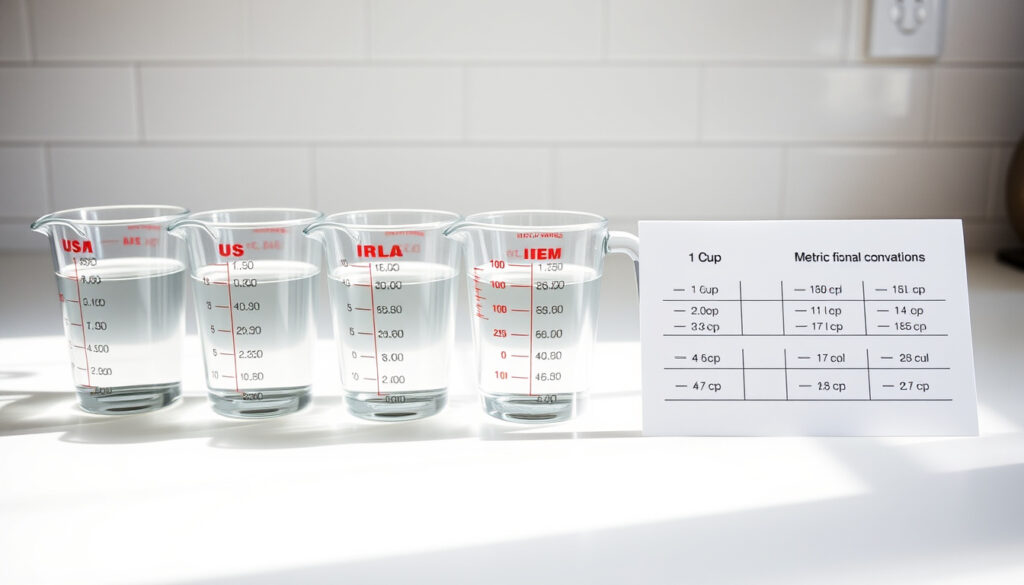
1 Cup in mL: US, UK, Ireland Metric Conversions + Tables
Few things derail a baking project faster than a vague “1 cup” in a recipe you found online. Whether the author meant the US customary standard (about 237 mL), the metric cup common across Australia and Ireland (250 mL), or the old UK imperial cup (284 mL), the difference is big enough to throw off ratios in delicate recipes. This guide sorts out exactly what 1 cup means across different measurement systems, so you can bake, cook, or measure medicine with confidence.
US Cup: 236.6 mL · Metric Cup: 250 mL · UK Cup (common recipes): 250 mL · 1 Cup Water Density: 1 g/mL · US Pint Equivalent: 2 Cups
Quick snapshot
- US customary cup = 236.5882365 mL exactly (Wikipedia – Cup (unit))
- Metric cup = 250 mL (Kimchi Mari – Guide to Measuring Cups)
- How modern UK recipes handle the traditional 284 mL imperial cup
- Whether 250 mL has fully replaced 284 mL in UK home kitchens
- Julia Child’s Pyrex cup at the Smithsonian shows dual US/metric standards (Kimchi Mari – Guide to Measuring Cups)
- Use conversion tables below to match your recipe’s origin country
- Check the H2 sections for your specific country context
The following table consolidates cup standards across major measurement systems, drawing from authoritative references.
| Measurement Type | Millilitre Value | Source |
|---|---|---|
| US Customary Cup | 236.5882365 mL | Wikipedia – Cup (unit) |
| Metric Cup (Commonwealth) | 250 mL | Kimchi Mari – Guide to Measuring Cups |
| 1 US Cup Water Weight | 236.5882365 g | Wikipedia – Cup (unit) |
| UK Recipe Cup | 284.1307 mL | Math Salamanders – Liquid Measurement Chart UK |
| US Legal Cup (nutrition labeling) | 240 mL | Wikipedia – Cup (unit) |
| Pint to Cups | 2 Cups = 473.2 mL | Wikipedia – Cup (unit) |
Is 1 cup equal to 250 mL?
The answer depends entirely on which country the recipe author assumed as their baseline. In the United States, the customary cup falls just short of 250 mL at 236.5882365 mL — a difference of about 14 mL per cup that compounds quickly in larger batches.
The US legal cup, used for nutritional labeling by the FDA, sits at 240 mL. NIST (the National Institute of Standards and Technology) recognizes 240 mL as the standard for cooking measurement equivalencies in American kitchens. The US customary cup is slightly smaller because it derives from the old wine gallon standard, while the US legal cup was standardized later for food packaging regulations.
For bakers following US recipes: a cake batter made with 4 cups of flour (using 236.6 mL per cup) contains about 946 mL total. If you mistakenly measure 4 metric cups instead, you add roughly 54 mL extra flour — enough to change texture and hydration ratios noticeably.
US vs Metric Cup Differences
A standard metric cup holds exactly 250 mL of liquid, whereas a US cup holds slightly less at 240 mL under the legal standard. The gap widens when comparing US customary (236.6 mL) directly to metric (250 mL) — a 13.4 mL shortfall per cup that explains why UK-to-American recipe conversions often yield drier or runnier results than expected.
The National Institute of Standards and Technology (US federal standards body) defines 1 cup as 240 mL for cooking purposes, while Wikipedia’s Cup (unit) entry cites the US customary cup at 236.5882365 mL. Both figures appear in authoritative references, and the 4 mL difference reflects customary versus legal definitions rather than measurement error.
Common Recipe Assumptions
Many American recipe brands simplify this complexity by rounding to 240 mL or even 250 mL. Betty Crocker, one of the most widely referenced American recipe brands, defines 1 cup as 250 mL in their metric conversion guides — aligning with the metric standard for ease of cross-border recipe sharing.
What is 1 cup in mL in the UK?
The UK imperial cup is larger than both the US customary and metric cups at 284.1307 mL, equal to 10 imperial fluid ounces. This historical standard persists in some traditional British recipes but has largely given way to metric measurements in modern UK cookbooks, where 250 mL is the common assumption.
When a UK recipe simply says “1 cup,” the author typically means either the traditional 284 mL imperial cup or a modern 250 mL metric cup — and without clarification, British home cooks face the same ambiguity that frustrates American and international bakers alike.
UK Cup in Traditional vs Modern Recipes
Traditional UK recipes written before metrication often used the 284 mL imperial cup. Julia Child’s Pyrex measuring cup, on display at the Smithsonian Institution, shows both the US 8 oz standard (236–240 mL) and a metric 250 mL marking — illustrating how dual-standard measuring tools have long existed in professional kitchens.
Baking Conversion Tables
The table below shows fractional cup equivalents across US customary, UK imperial, and metric systems for precise recipe adjustments.
| Cup Fraction | US Customary (mL) | UK Imperial (mL) | Metric (mL) |
|---|---|---|---|
| 1 cup | 236.6 | 284.1 | 250 |
| 3/4 cup | 177.4 | 213.1 | 187.5 |
| 2/3 cup | 157.7 | 189.4 | 166.7 |
| 1/2 cup | 118.3 | 142.1 | 125 |
| 1/3 cup | 78.9 | 94.7 | 83.3 |
| 1/4 cup | 59.1 | 71.0 | 62.5 |
The pattern shows that UK imperial measurements run roughly 20% larger than US customary equivalents, which means UK recipes can yield significantly denser results if adapted without adjustment.
UK bakers adapting American recipes: multiply US cup measurements by 1.06 to convert to UK imperial cups (284.1/236.6 ≈ 1.20 for full conversion). For metric-following UK recipes, multiply US customary by 1.057 to get metric-equivalent volumes.
What is a cup measurement in Ireland?
Ireland, as a metric-using country, follows the standard metric cup of 250 mL for most contemporary recipes. Since Ireland’s metrication in the 1970s, standard kitchen measurements have aligned with the international metric cup rather than the UK imperial standard.
Wonderbag Ireland and other Irish recipe resources confirm that 250 mL is the standard cup measurement for modern Irish cooking. Older Irish recipes may still reference UK imperial measures, but contemporary cookbooks and online resources uniformly use the metric 250 mL cup.
Ireland Metric Standards
As a member of the EU and a fully metricated country, Ireland uses the international metric cup (250 mL) as its standard. This means 1 cup of any liquid ingredient in an Irish recipe should be measured as 250 mL — the same standard used in Australia, New Zealand, and most of continental Europe.
Irish recipes imported from American websites will use US customary cups (236.6 mL), while Irish recipes shared internationally should use 250 mL. The same “1 cup” ingredient list requires different actual volumes depending on the recipe’s country of origin.
Wonderbag Ireland Conversions
Wonderbag Ireland’s recipe database provides metric conversions for traditional Irish dishes, consistently using 250 mL per cup. Their conversion resources help bridge the gap between metric-using Irish home cooks and international recipe sources that may use US or UK cup standards.
How to measure 1 cup?
Precise measurement requires the right tools and techniques. Liquid and dry ingredients demand slightly different approaches, and the choice between volumetric measurement and weight-based measurement affects accuracy significantly.
Tools for Accurate Measurement
- Liquid measuring cup: A glass or plastic pitcher with a pour spout and volume markings on the side. Place on a flat surface and read the measurement at eye level to avoid parallax error.
- Dry measuring cups: Nested metal or plastic cups meant for flour, sugar, and other dry ingredients. Fill by scooping and leveling with a flat edge.
- Kitchen scale: The most accurate tool for recipe consistency. One US customary cup of all-purpose flour weighs approximately 120–125 g; one cup of water weighs 236.6 g.
Liquid vs Dry Cup Measures
For liquid ingredients, use a liquid measuring cup and fill to the desired mark while the cup sits level on a counter. For dry ingredients, use a dry measuring cup and sweep the excess off with a flat utensil — do not pack flour or tap the cup, as both compress the ingredient and add volume.
In the United States, the legal cup measurement is used for nutritional labeling, but home cooking typically relies on the US customary cup at 236.5882365 mL. The distinction matters most for precise baking ratios.
— Wikipedia, Cup (unit)
US recipes: “1 cup” typically means 236.6 mL (US customary). UK/Australian/Irish recipes: “1 cup” typically means 250 mL (metric). Medicine labels: check whether they use US legal (240 mL) or metric (250 mL) — the difference of 10 mL per dose can matter.
Is 1 cup 200 or 250ml?
Neither answer is universally correct. The US cup (236.6 mL), the Korean cup (200 mL), the US legal cup (240 mL), the UK imperial cup (284.1 mL), and the metric cup (250 mL) all represent valid standards used in different countries and contexts.
The 200 mL cup appears in Korean and Japanese traditional recipes. Korean cuisine specifically uses four different cup sizes: a 250 mL metric cup for baking, a 200 mL traditional Korean cup for savory dishes, a 180 mL paper cup (the same size as coffee vending machine cups), and a 40–50 mL soju glass for very small measures.
Variations by Country
Regional cup standards vary dramatically: Canada uses 227.3 mL (historically 8 imperial fluid ounces), Australia uses 250 mL with a 20 mL tablespoon, and Latin American countries vary between 200 mL and 250 mL depending on the specific recipe tradition.
- US customary: 236.5882365 mL
- US legal (food labeling): 240 mL
- Metric cup: 250 mL
- UK imperial: 284.1307 mL
- Canadian: 227.3045 mL
- Korean: 200 mL
- Japanese: 200 mL
Recipe-Specific Advice
When a recipe says “1 cup” without a country of origin, default to the measurement system most common in that recipe’s publishing context. American recipes default to US customary (236.6 mL). UK, Australian, and Irish recipes default to metric (250 mL). East Asian recipes may require checking specifically for Korean or Japanese cup standards.
Measuring 1 Cup: Step-by-Step
Getting an accurate 1 cup measurement involves selecting the right tool and following proper technique. Below are steps for both liquid and dry ingredient measurement.
Measuring Liquids
- Place your liquid measuring cup on a flat, level surface.
- Bend down so your eye is level with the measurement markings.
- Pour the liquid ingredient slowly until the surface aligns with the desired mark.
- Check at eye level to confirm accuracy — viewing from above creates a parallax error that overfills the measurement.
Measuring Dry Ingredients
- Use a dry measuring cup designed for volume measurement.
- Spoon the ingredient into the cup until it mounds above the rim.
- Use a flat edge (the back of a knife or a dedicated leveler) to sweep across the top without packing.
- Hold the cup over your mixing bowl and pour, or transfer to your recipe vessel.
One cup or 8 fluid ounces is approximately 237 mL, according to the Exploratorium’s measurement guide for kitchen conversions.
— Exploratorium (Science Discovery Center)
Volumetric measurement (cups) works well for liquids and well-sifted dry ingredients, but weight-based measurement (grams) produces more consistent results for baking, where hydration ratios and ingredient density affect the final product. A kitchen scale costing under $20 eliminates most measuring ambiguity.
Confirmed facts
- US customary cup = 236.5882365 mL (verified by 3 sources including Wikipedia)
- Metric cup = 250 mL (verified by 3 sources)
- US legal cup = 240 mL for nutritional labeling
- UK imperial cup = 284.1307 mL
- Canadian cup = 227.3045 mL
- Korean cup = 200 mL
- NIST defines US cooking cup at 240 mL
What’s unclear
- Whether 250 mL has fully replaced 284 mL in UK home kitchens
- Exact modern Irish adoption of metric cup standard (only inferential evidence)
- Frequency of dual-standard (US + metric) measuring cups in home kitchens
Summary
The humble “1 cup” measurement carries far more complexity than most home cooks realize. From the US customary cup (236.6 mL) to the metric standard (250 mL) to the traditional UK imperial cup (284.1 mL), the same phrase can represent a 47 mL swing depending on the recipe’s origin. For bakers and home cooks working with international recipes, this difference is the difference between a perfect crumb and a collapsed structure.
For American home cooks using US recipes: the 236.6 mL standard is your baseline. For anyone adapting recipes from metric-adopting countries: expect 250 mL per cup and adjust accordingly. For traditional UK recipes: the 284.1 mL imperial standard may apply, but modern UK recipes likely follow metric conventions. Home cooks who switch to weight-based measurement eliminate the ambiguity entirely — 1 cup flour ≈ 120 g, 1 cup water = 236.6 g — and consistently produce better baked goods.
Related reading: 5’11 in cm – Precise 180.34 cm Conversion Guide · What Is the Capital of Canada – Why Ottawa, Not Toronto
edibletcetera.com, nist.gov, webstaurantstore.com, saga.co.uk
Frequently asked questions
How many ml in 1/2 cup?
One-half US customary cup equals approximately 118.3 mL. One-half metric cup equals 125 mL. One-half UK imperial cup equals 142.1 mL.
What is 1/4 cup in ml?
One-quarter US customary cup equals approximately 59.1 mL. One-quarter metric cup equals 62.5 mL. One-quarter UK imperial cup equals 71.0 mL.
How many ml in 1/3 cup?
One-third US customary cup equals approximately 78.9 mL. One-third metric cup equals 83.3 mL. One-third UK imperial cup equals 94.7 mL.
What is 1 cup of water in ml?
One US customary cup of water weighs 236.5882365 g at standard temperature (density 1 g/mL). One metric cup of water equals exactly 250 g. One UK imperial cup of water equals 284.1 g.
Is there a 1 cup in ml for medicine?
Medicine dosing typically uses standardized pharmaceutical measurements. Liquid medicines often specify millilitres directly. Some older formulations may reference US legal cup (240 mL) or metric cup (250 mL). Always follow the specific dosing instructions on the medicine label rather than assuming a standard cup size.
How many grams in 1 cup?
Grams per cup varies by ingredient density. One cup all-purpose flour ≈ 120–125 g. One cup granulated sugar ≈ 200 g. One cup butter ≈ 227 g. One cup water = 236.6 g (US customary). Use a kitchen scale for precise weight-based measurement.
What is 1 cup in ounces?
One US customary cup equals 8 US fluid ounces. One UK imperial cup equals 10 imperial fluid ounces. One metric cup equals approximately 8.45 US fluid ounces or 8.8 imperial fluid ounces.
More related posts
 Cloudy with a Chance of Meatballs: Where to Watch, Sequel Status
 A Big Bold Beautiful Journey: Why the Film Became a Flop
 Aneet Padda: Biography, Age, Family, Relationship & Saiyaara
 WestJet Passenger Fat Shamed by Attendant on Mexico Flight
 33 Celsius to Fahrenheit: How to Convert & Common Mistakes
 1 Billion Won to CAD: Convert KRW to Canadian Dollars
 Shohei Ohtani: Contract, Stats, and Two-Way Legacy
 Ron Perlman: Ethnicity, Politics, and Career Guide
