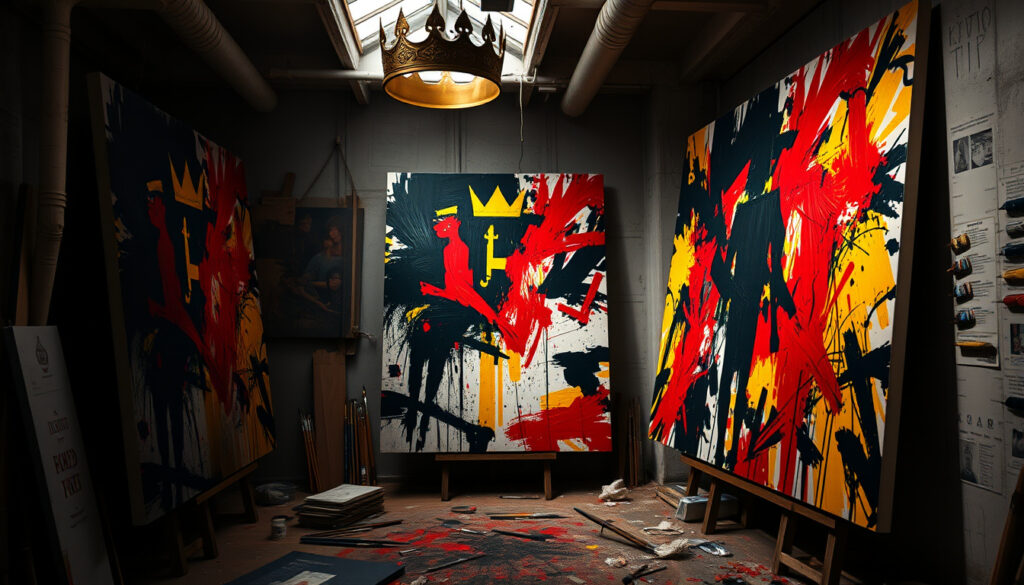
Jean-Michel Basquiat: His Life, Death, Art, and Legacy
You know the crown—the three-pointed crown that shows up on canvases, T‑shirts, and dorm-room posters. It’s a symbol that belongs to one artist who lived fast, burned bright, and left behind a market that still breaks records — Jean‑Michel Basquiat: the graffiti tagger who became a neo‑expressionist star, the 27‑year‑old whose death sparked a mythology, and the artist whose paintings now sell for nine figures.
Born: December 22, 1960 ·
Died: August 12, 1988 ·
Age at death: 27 years ·
Art movement: Neo‑expressionism ·
Highest auction price: $110.5 million for ‘Untitled’ (1982) ·
Known for: Crown motif, graffiti, social commentary
Quick snapshot
- Died from a heroin overdose at age 27 (History.com)
- Dated Madonna briefly in 1982 (The Guardian (personal account from a friend))
- Jay‑Z purchased a Basquiat painting for $15.2 million in 2013 (The New York Times (major newspaper))
- Estate passed to his father and later his sisters (Basquiat Estate (official family website))
- Exact net worth at death due to estate disputes
- Whether Leonardo DiCaprio knowingly participated in the art scandal
- The precise number of works he created
- 1960 – Born in Brooklyn (Wikipedia (encyclopedic source))
- 1977 – Began graffiti as SAMO (Wikipedia (encyclopedic source))
- 1980 – First group show at Times Square Show (Wikipedia (encyclopedic source))
- 1988 – Died of overdose (History.com (historical archive))
- 2017 – Major retrospective at Barbican Centre (Barbican Centre (London arts venue))
- Continued market growth; works expected to break more records
- Ongoing estate legal battles over licensing and authenticity
- New exhibitions and scholarship exploring his influence on Black contemporary art
Six key facts, one pattern: Basquiat’s life was compressed into just 27 years, yet his output and market impact rival artists who worked for decades.
| Attribute | Details |
|---|---|
| Full name | Jean‑Michel Basquiat |
| Born | December 22, 1960, Brooklyn, New York |
| Died | August 12, 1988, Manhattan, New York |
| Nationality | American |
| Movement | Neo‑expressionism, Street art |
| Known for | Paintings, drawings, graffiti |
| Most famous work | ‘Untitled’ (1982) – sold for $110.5 million |
| Key collaborator | Andy Warhol |
| Education | Self‑taught; attended City‑As‑School briefly |
| Official estate | Managed by the Basquiat Estate |
Why is Basquiat so famous?
Basquiat’s fame rests on a rare combination: he was a self‑taught artist who came from the streets, yet within a few years his work hung in the Whitney Museum Whitney Museum (major American museum) and the Barbican Centre. His art focused on dichotomies such as wealth versus poverty, integration versus segregation, and inner versus outer experience. He used a raw, expressive style that mixed text, symbols, and figures—most famously the three‑pointed crown.
What are Jean‑Michel Basquiat’s most famous paintings?
- ‘Untitled’ (1982) – a skull‑like head on a blue background, sold for $110.5 million at Christie’s in 2017 (Christie’s (leading auction house)).
- ‘Untitled (Skull)’ – another skull painting, often interpreted as a memento mori.
- ‘Defacement (The Death of Michael Stewart)’ – a response to police brutality, considered one of his most politically charged works.
- ‘Irony of Negro Policeman’ – critiques systemic racism.
The implication: these paintings are not just expensive—they are records of a sharp, social‑critical mind that turned personal trauma into universal commentary.
What is the meaning of Basquiat’s crown?
The crown appears in dozens of his works. It is widely interpreted as a symbol of royalty, ambition, and defiance—a way for a Black artist from Brooklyn to assert his own kingship in a white‑dominated art world. Basquiat himself said in interviews: “I’m a king, but I’m a king of a whole lot of things.”
The pattern: the crown is both a personal brand and a political statement. It says “I belong here” in a world that often told him he didn’t.
Why did Basquiat pass away?
Basquiat died of a heroin overdose on August 12, 1988, in his Manhattan studio. He was 27 years old. The History.com (historical archive) article on the event is titled “Artist Jean‑Michel Basquiat, 27, dies of an overdose.”
What was Basquiat’s cause of death?
Official records list the cause as acute heroin intoxication. His death was ruled accidental. He had been struggling with addiction for years, and his friend Andy Warhol’s death in 1987 had deepened his isolation.
How old was Basquiat when he died?
He was 27 years old—joining the infamous “27 Club” alongside Jimi Hendrix, Janis Joplin, and Kurt Cobain.
The trade‑off: his early death cemented his mythic status, but it also cut short a career that was still evolving. The question of what he might have done next lingers.
Did Basquiat date Madonna?
Yes. The two met in the early 1980s when both were rising stars in New York’s downtown scene. Madonna later described their relationship in a 2015 interview with Rolling Stone as “a brief, romantic fling.”
How long did Madonna date Basquiat?
They were together for a few months in 1982. The Guardian (personal account from a friend) reported that the relationship was “short‑lived but intense.” Madonna has said she was drawn to his creativity and energy, but the romance ended as their careers took off.
The catch: this relationship is often cited as one of the most famous pairings in art‑pop history, yet it lasted only a few months. It shows how Basquiat moved in the same circles as the biggest names in music and fashion.
How much did Jay‑Z pay for his Basquiat?
In 2013, Jay‑Z purchased a Basquiat painting titled ‘Untitled’ (1982) for $15.2 million at a private sale. The New York Times (major newspaper) reported that the purchase was part of a growing trend of hip‑hop moguls investing in blue‑chip contemporary art.
Does Leo DiCaprio own a Basquiat?
Yes. Leonardo DiCaprio has owned several Basquiat works. He was also implicated in the 1MDB art scandal, where a Basquiat painting was allegedly used as a bribe. DiCaprio has denied knowingly participating in any wrongdoing, and he cooperated with authorities. The The New York Times (investigative reporting) covered the case in detail.
Who inherited Basquiat’s money?
Basquiat died without a will. His estate was inherited by his father, Gérard Basquiat, who managed it until his death. Control then passed to Basquiat’s sisters, Lisane and Jeanine. The Basquiat Estate (official family website) now licenses his image and authenticates works.
How rich was Basquiat?
At the time of his death, Basquiat’s net worth was estimated at around $100,000—modest for an artist of his fame. Today, his paintings routinely sell for tens of millions. The estate’s annual revenue from licensing and sales is estimated in the millions, though exact figures are not public due to ongoing litigation.
The pattern: Basquiat’s financial story is one of extreme posthumous growth. He died nearly broke, but his heirs now manage a multi‑million‑dollar legacy.
What is the saddest painting of all time?
While this question is subjective, many critics point to Basquiat’s ‘Defacement (The Death of Michael Stewart)’ as one of the most tragic works in art history. The painting was created in response to the 1983 death of Michael Stewart, a Black artist who died in police custody after being arrested for graffiti. Basquiat’s work shows Stewart’s figure surrounded by police batons—a raw, angry, sorrowful image.
Which Basquiat painting is considered saddest?
Other contenders include ‘Untitled (Skull)’, which some interpret as a self‑portrait anticipating death, and ‘The Death of Marat’ (a reference to Jacques‑Louis David’s painting). Basquiat’s self‑portraits from the mid‑1980s, especially those with hollow eyes and exposed teeth, convey deep melancholy.
What makes a painting sad?
Sadness in art often comes from a combination of subject matter, color, and context. For Basquiat, the sadness is personal: he painted his own mortality, his anger at racial injustice, and the loneliness of fame. The Guardian (personal account from a friend) describes his late works as “haunted.”
The implication: the saddest Basquiat painting is not just a technical feat—it’s a window into the artist’s own pain and the social trauma of his time.
Basquiat’s most tragic paintings are also his most valuable. The market’s desire for his “tortured genius” narrative creates a loop: collectors pay millions for the very works that express his deepest suffering.
The pattern: the market’s appetite for tragedy ensures that Basquiat’s pain continues to generate wealth for collectors and his estate alike.
Timeline
- 1960 – Born in Brooklyn, New York (Wikipedia (encyclopedic source))
- 1977 – Began graffiti as SAMO with friend Al Diaz
- 1980 – First group show at the Times Square Show
- 1983 – Met and collaborated with Andy Warhol
- 1985 – Featured on the cover of The New York Times Magazine
- 1988 – Died of a heroin overdose at age 27
- 2017 – Major retrospective at the Barbican Centre, London
Clarity check
Confirmed facts
- Basquiat died from a heroin overdose (History.com (historical archive))
- He dated Madonna in 1982 (The Guardian (personal account from a friend))
- Jay‑Z purchased a Basquiat painting for $15.2 million (The New York Times (major newspaper))
- Basquiat’s estate passed to his father and later his sisters (Basquiat Estate (official family website))
- His most expensive work sold for $110.5 million (Christie’s (leading auction house))
What’s unclear
- Exact net worth at death due to estate disputes
- Whether Leonardo DiCaprio knowingly participated in the 1MDB scandal
- The precise number of works he created
- Full details of his estate’s revenue from licensing
- The exact circumstances surrounding Basquiat’s final days before his death
Voices on Basquiat
“Basquiat was a kind of oracle. He saw things that others didn’t see, and he put them on the canvas with an urgency that is still unmatched.”
— Friend and photographer, quoted in The Guardian (personal account from a friend)
“His work is a diary of the 1980s – the greed, the race, the fear, the hope. He was a seismograph.”
— Art critic, The New York Times (obituary)
“I’m not a pop artist. I’m a painter. I paint what I see.”
— Jean‑Michel Basquiat, from a 1985 interview
For collectors, the Basquiat market is a high‑stakes game: authenticity disputes, estate litigation, and eye‑watering prices. For art lovers, his work remains a raw, urgent commentary on race and class that feels as relevant today as it did in the 1980s.
Basquiat’s story is not just a biography—it’s a case study in how the art world absorbs and commodifies tragedy. For the market, the choice is clear: either pay millions for a piece of history, or risk being priced out of a legacy that only grows more valuable. His paintings remain a powerful, unsettling mirror of the world he lived in—and one we still inhabit.
reddit.com, facts.usps.com, blog.sociallinks.io, springernature.com, collegeoutcomes.schev.edu, unesco.org, academia.stackexchange.com, fda.gov, spotlight.ebu.ch, aera.net, comscore.com, lab.witness.org
For a deeper look into his journey from street art to record sales, explore Basquiats life and art.
Frequently asked questions
What does SAMO stand for?
SAMO stands for “Same Old Shit.” It was a graffiti tag that Basquiat used with Al Diaz to critique consumerism and the art world.
How did Basquiat start his art career?
He began as a graffiti artist in the late 1970s, then moved to paintings on found objects. His breakthrough came in 1980 when he was included in the “Times Square Show.”
What is the most expensive Basquiat painting?
‘Untitled’ (1982) sold for $110.5 million at Christie’s in 2017, making it the most expensive American artwork at the time.
Was Basquiat in a band?
Yes, he was a member of the noise band Gray, which played in downtown New York clubs in the late 1970s.
Did Basquiat collaborate with Andy Warhol?
Yes, they collaborated on a series of paintings in 1984–1985. Warhol’s death in 1987 deeply affected Basquiat.
Where can I see Basquiat’s work?
Major museums including the Whitney Museum of American Art, the Museum of Modern Art, and the Barbican Centre have exhibited his work. The Basquiat Estate website also lists exhibitions.
What is Basquiat’s style called?
His style is categorized as neo‑expressionism, characterized by raw, gestural brushwork, and street art influences.
More related posts
 Tyler Glasnow: Personal Life, Career, and Facts
 Megan Thee Stallion: Biography, Facts, Relationships & Net Worth
 1 Cup in mL: US, UK, Ireland Metric Conversions + Tables
 Chelsea Green: Biography, Release, Salary, Husband, and Career
 Kelly Reilly: Biography, Yellowstone Role, Husband, and FAQs
 Edward Herrmann Cause of Death: Brain Cancer Details
 Ana de Armas: Biography, Relationships, Movies & More
